Shared viewing.
In recentyears, the impact of shared viewing has been increasingly undervalued.

Shared viewing.

In recent years, the impact of shared viewing has been increasingly undervalued.
The perception is that screens are now personal. Attention is fragmented. Viewing is increasingly individual, driven by mobile devices, social platforms, and on demand environments.
Because shared viewing is seen as less prevalent, the thinking goes, it must be no longer as impactful.
What the data shows, including here in New Zealand, is something more nuanced.
Shared viewing remains a meaningful part of how television is experienced, and it continues to drive television’s effectiveness as an advertising medium.
This is not about nostalgia. It is about how viewing ads in a shared environment impacts our behaviour, and how optimising advertising engagement goes beyond the screen or content they are displayed on.
Television is experienced in shared spaces.
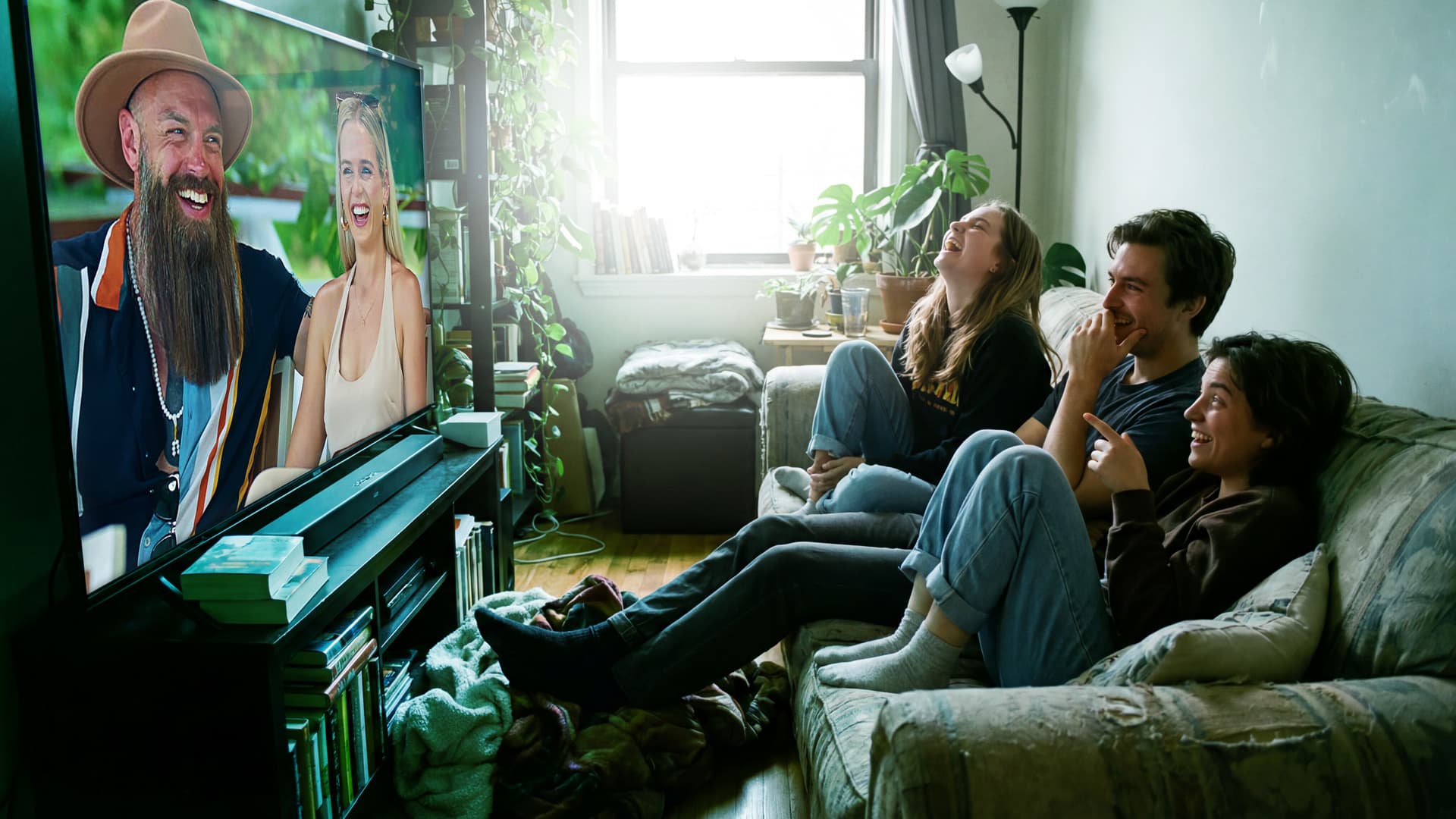
Television content, whether linear or BVOD, is still primarily watched on the largest screen in the home. By its very nature, that screen tends to sit in a shared room, with couches and chairs arranged around it.
That physical setup matters.
A central screen encourages co-presence. It creates conditions where viewing is more likely to be collective rather than solitary.
This does not mean every television moment is shared, but it does mean television is inherently predisposed to shared viewing in a way personal devices are not.
Shared viewing shapes behaviour, and behaviour shapes outcomes.
Younger audiences share too.
One of the most persistent assumptions in media planning is that younger audiences only consume video on their personal devices.
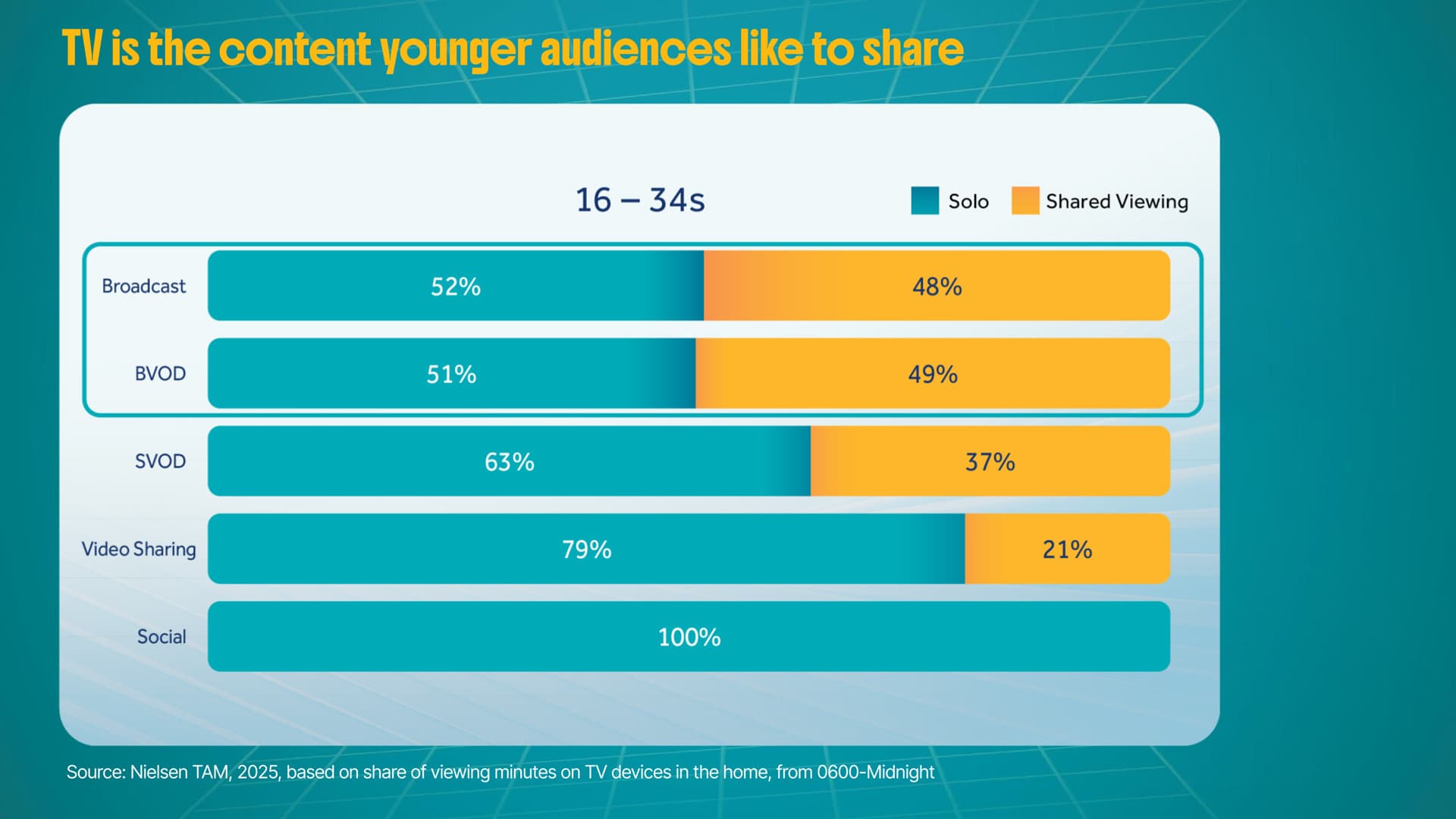
But the data shows that half of all television viewing for 16 to 34 year olds is shared.
The old behaviour of popping the telly on at 6pm and off at 9pm might have changed, but that does not mean younger viewers have totally abandoned traditional viewing habits.
They still watch together. They are simply more selective about what they choose to watch.
This challenges the idea that television has lost its social dimension for younger viewers.
.jpg)
Shared viewing is not evenly distributed across all video environments.
As these charts show - linear television and BVOD are significantly more likely to be shared than other forms of video consumption for younger audiences.
Social and short form video skew strongly towards solo viewing.
Live sport, entertainment formats, reality programming, major news moments, and culturally relevant events are still watched together.
Television content is often designed to be experienced collectively, and that design still works.
In New Zealand, shared viewing is not marginal. During prime time, around 80% of people watching television are doing so with at least one other person present.
Why is shared viewing of value to advertisers? Because it changes how attention works.
There is a long held assumption that more people in the room means more distraction.
In reality, watching together amplifies emotional response, sharpens focus, and strengthens social cues.
Advertising placed within these shared moments benefits from that amplification, boosting attention, emotional impact, and perceptions of fame and trust for advertised brands.
This is not about distraction. It is about reinforcement.
When reactions are shared, attention is held longer, and messages land more deeply.
‘When television is watched with others, attention doesn’t fragment. It concentrates. Shared viewing amplifies emotional response and strengthens trust in the brands people see.’
- Sharon Daley, Sky New Zealand
Perception about the decline in the value of shared viewing stands in stark contrast to our increasingly sophisticated understanding of the impact of attention.
Industry thinking has increasingly shifted from simply measuring exposure to understanding the quality of attention.
WARC’s concept of Satisfied Attention reframes effectiveness away from raw reach and towards the conditions under which attention is most valuable.
Attention is shaped by, among other things, enjoyment, context, and emotional engagement.
When viewers feel satisfied with the content they are watching, they are more open, more receptive, and more likely to process advertising messages positively.
Shared viewing contributes directly to this effect.
Watching together often increases enjoyment and memorability, reinforcing the impact of both content and advertising.
This is not about bigger numbers. It is about better moments.
Shared experiences extend beyond the room.
The impact of shared viewing does not stop when the programme ends.
People talk about what they watched at the dinner table, at work, and with friends.
Moments from television become reference points for conversation and connection.
Those conversations reinforce memory and extend the life of the content.
Advertising embedded within those moments benefits from the same reinforcement.
Shared viewing allows television experiences to travel beyond the screen and embed itself in everyday social moments, sometimes into the cultural zeitgeist itself.
Live viewing continues to play a critical role in shared television experiences.
Sport is the clearest example, but it is not the only one.
Reality finales, breaking news, and culturally significant broadcasts still bring people together at the same time.
Live moments create occasions.
For advertisers, these moments offer environments where attention, emotion, and satisfaction intersect.
When people choose to watch together, and when they know others are watching too, attention tends to stabilise. Emotion is shared. Memory is reinforced.
This is where television continues to set itself apart, not just by what it reaches, but by the conditions it creates while it is being watched.
For planners, the implication is simple. Shared viewing is not an optional footnote. It is a real contributor to effectiveness, and it deserves to be accounted for in modern planning decisions.
What this means for planners
Efficiency remains important. But efficiency without context is incomplete. Reaching audiences at scale is not the same as reaching them in moments where attention is genuinely available and engagement is more likely to form.
Shared viewing environments deliver stronger attention, higher satisfaction, deeper memory, and extended social reinforcement.
When people enjoy what they’re watching together, advertising doesn’t interrupt the experience, it becomes part of it.
- Jacqueline Freeman, ThinkTV
Why it still matters
Shared viewing is proven to deliver some of the harder to measure, less tangible, but still highly impactful factors that drive effective advertising. From stronger attention to heightened emotional response, from talkability and shareability to being part of the collective conversation.
Shared viewing moments also tend to align with moments of strong focus from large audiences. Live sport, matches and competitions, reality show grand finals, full season binge watch sessions, and other culturally significant content are often watched together.
Where there is shared viewing, there is frequently appointment viewing, and that creates powerful attention conditions, the kind of sustained, high quality attention that brands and clients want for their campaigns.
Sources
- Nielsen TAM New Zealand, television co viewing and primetime data, 2025
- Nielsen Total Video New Zealand, share of viewing minutes across device types, 2025
- Thinkbox UK, shared viewing and context effects research
- BARB, UK television measurement
- Context Effects, advertising attention and recall studies
- WARC, ‘Satisfied Attention’ framework
- GWI, audience behaviour and effectiveness research
- FreeWheel and NBCUniversal, live and shared viewing effectiveness studies